Use our Truck Loan Calculator to estimate repayments, compare finance options, and plan your purchase with ease. Fast, simple, and tailored for Australian businesses and drivers.
'Calculator results are estimates only and not quotes. Actual quotes will be provided by licensed brokers after you submit an enquiry.'
Truck Loan Details:
Important!
Truck Loan Interest Rates differ from lender to lender and will depend on your individual circumstances (credit history, employment status, age, etc.). To find out if you qualify ... and for a free, personalised interest rate and repayment quote,
please CLICK HERE
Truck Loan Amortisation Calculator
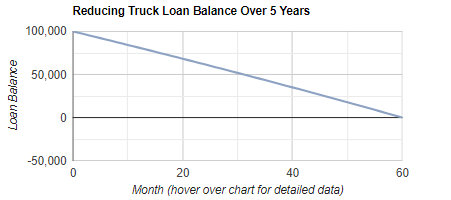
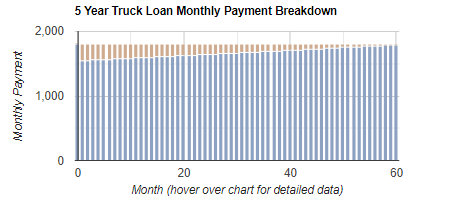
The following amortisation graphs detail month-by-month data on the progress of the proposed loan. The first chart below examines the reducing loan balance over the course of the finance contract term. The second graph illustrates the portion of each monthly repayment allocated to payment of interest vs principal reduction.
How to use our Truck Loan Repayment Calculator
Our Truck Loan Repayment Calculator helps Australian drivers and businesses estimate loan repayments before you commit. It is designed to support budgeting, cash flow planning, and comparing truck finance scenarios by showing how changes to price, deposit, term, and interest rate can affect your repayments and total interest cost.
How to complete the calculator for the most accurate estimate
1. Purchase Price
Enter the total purchase price of the truck you plan to finance. Consider including eligible on-road and purchase-related costs that may be financed (for example registration, insurance, or other costs where applicable). Use whole numbers only, without commas or decimals.
2. Deposit or Trade-in Value
If you are paying an upfront deposit or using a trade-in, enter that amount here. This reduces the amount you need to borrow and can lower repayments and total interest. Use whole numbers only.
3. Term of Loan (Years)
Select the loan term in years. In general, a longer term can reduce the periodic repayment but may increase the total interest paid over the life of the loan. Choose a term that suits your expected truck usage and business cash flow.
4. Interest Rate (Percent per annum)
Select an interest rate to model your scenario. Rates vary by lender and borrower circumstances, so it can be helpful to test a conservative rate as well as an optimistic one.
5. Calculate
Select calculate to generate your repayment estimate and repayment breakdown visuals.
How to interpret your results
1. Repayment estimate
Use this as a guide to affordability and budgeting. If the repayment is tight, test a higher deposit, shorter term, or different interest rate.
2. Amortisation and graphs
Review how the loan balance reduces over time, and how each repayment typically shifts from mostly interest early on to more principal later. This can help with planning for refinancing, early payout, or upgrade timing.
ASIC compliance note: This calculator provides information only and is not financial or credit advice. Results are estimates and may not include all fees, charges, taxes, residuals or balloon payments. Consider your objectives and financial situation, and seek independent advice or a lender quote before proceeding.
Australia's push towards higher-productivity heavy vehicles is again in focus, with recent industry attention turning to Performance Based Standards access and the way approved combinations can move more freight with fewer trips. For small fleet operators and owner-drivers, the practical message is clear: a truck purchase is no longer just about horsepower, brand preference or sticker price. It is about whether the vehicle can legally and efficiently perform the work it is being financed to do. - read more
Australia’s truck market appears to be entering spring with buyers still taking a measured approach. The latest industry reporting points to ongoing softness in new truck demand, extending the cautious market conditions already evident through winter. For owner-drivers, tradies and small fleet operators, this is not simply a sales trend. It changes the way truck purchases should be timed, negotiated and financed. - read more
Australia's truck market appears to be settling into a more cautious phase, with the latest July industry updates pointing to softer buyer demand after an already subdued first half of the year. For owner-drivers, tradies and small fleet operators, the story is not simply about fewer trucks changing hands. It is about how a cooler market can affect pricing, availability, trade-in values and finance timing. - read more
Australia’s truck market is moving into a new buying cycle, with Isuzu’s latest model range putting a sharper focus on safety, emissions performance, driver comfort and connected technology. For owner-operators and small fleet businesses, the announcement is more than a product update. It is a reminder that truck purchasing decisions are increasingly tied to whole-of-life cost, compliance expectations and the ability to keep vehicles earning without avoidable downtime. - read more
Truck loan interest rates and repayments can vary widely depending on the borrower, the truck, the loan structure and the lender's criteria. This guide explains the main factors that influence commercial truck loan costs in Australia. - read more
Are you thinking about getting a new or used truck but unsure of which one is the better choice? This article is here to help guide you through the financial considerations involved in truck loans. We'll talk through what makes new trucks so appealing, with their cutting-edge tech and features, and what makes used trucks a more budget-friendly option. - read more
When it comes to financing a truck, whether for business or personal use, one of the first decisions you'll face is whether to invest in a new or used vehicle. This choice is more than a mere preference; it has significant financial implications that can affect your business's bottom line. - read more
The transport industry is vital to the Australian economy, providing crucial services that enable the movement of goods and people across the country. As demand increases, the importance of growth in this sector cannot be overstated. Whether it's a small business looking to expand its fleet or a larger company aiming to cover more routes, scaling up is a key goal for many transport businesses. - read more
Knowledgebase
Prepayment Penalty: A fee charged by a lender if a borrower pays off their loan early.